
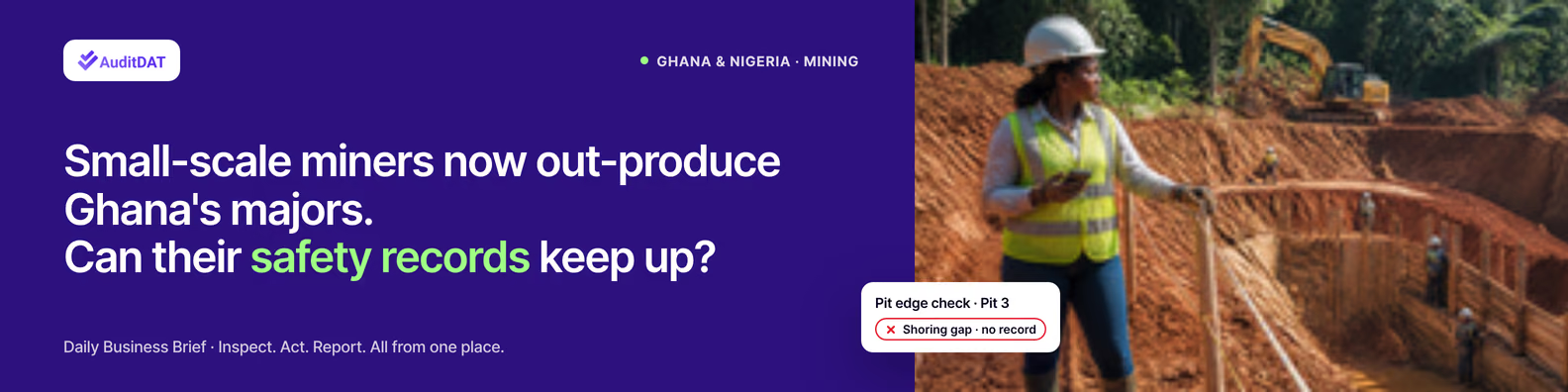
Small-scale mining now out-produces the majors. Its safety records haven't caught up.
 Joseph Abeiku Ansah-Gordon
Product Owner/Lead Marketing ·
In 2025, Ghana's artisanal and small-scale miners produced more gold than its large mines for the first time. As both Ghana and Nigeria push small operators into the formal system, the ones with credible safety records will be best placed.
Share


The shift
Ghana's gold economy has a new centre of gravity. According to the Ghana Gold Board (GoldBod), artisanal and small-scale mining (ASM) produced a record 104 tonnes in 2025, overtaking large-scale mining for the first time. ASM generated nearly US$11 billion in foreign exchange that year, against about US$9 billion from the large miners.
The trend is holding. In July 2026, GoldBod's CEO Samuel Gyamfi said first-half purchases were around 50 to 54 tonnes, and that 2026 output was "likely to match or even surpass" the 2025 record.
That makes small-scale operators, cooperatives and the contractors who serve them one of the most important parts of West Africa's mining economy, and one of the least documented.
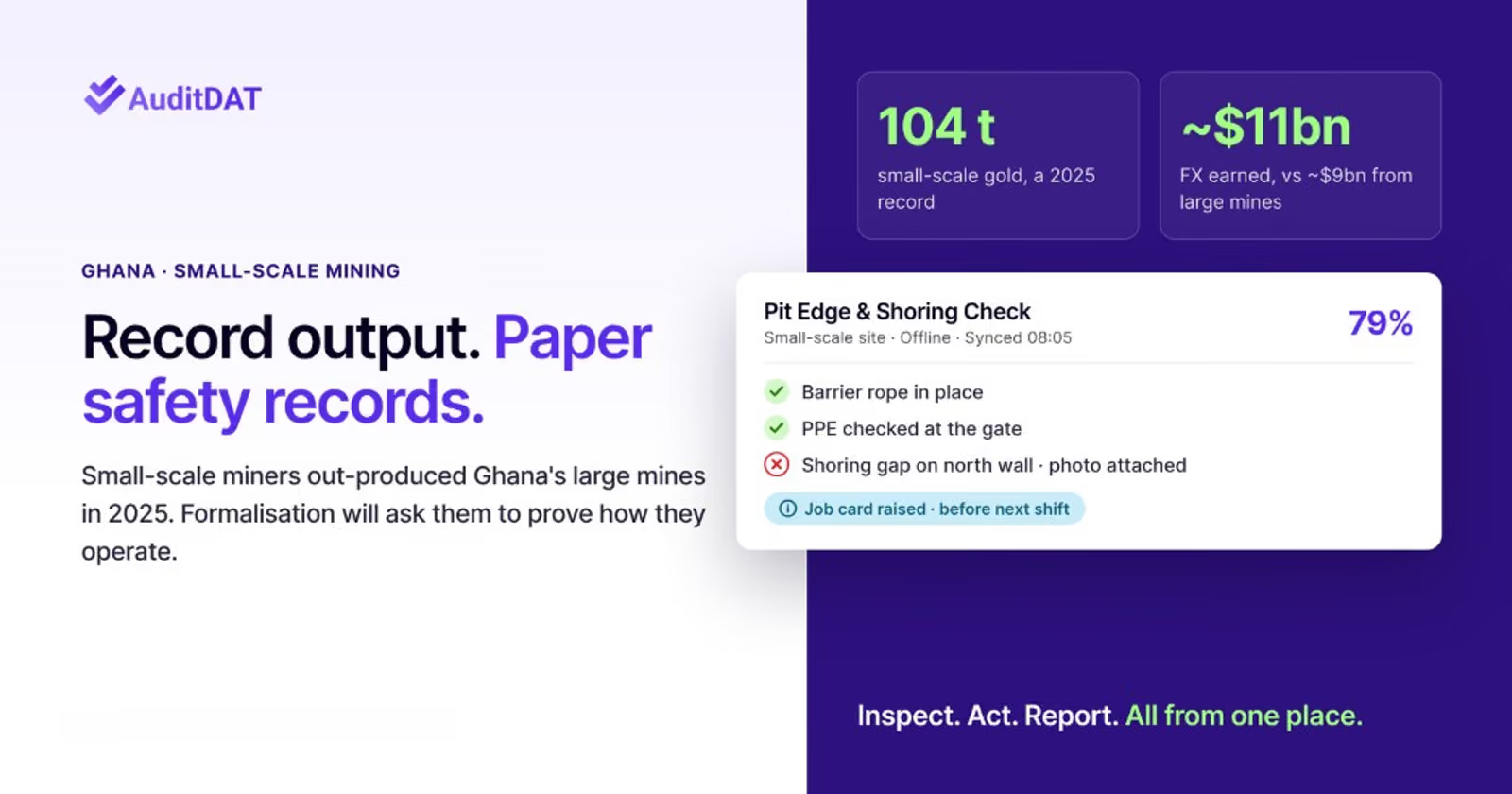
Output has scaled. Safety records haven't.
Large mines run formal safety management systems, with dedicated HSE teams, audited procedures and digital reporting. Most small-scale sites run on experience, a supervisor's memory and, at best, a paper checklist.
The cost of that gap shows up in the news. In February 2026, three miners were killed when a slab of rock broke loose in an underground pit near Gbane, in Ghana's Upper East Region. The area has long been associated with intensive small-scale gold mining, and police said investigators would look at whether proper safety measures were in place. In Nigeria, where most mining is artisanal, a run of pit collapses and a suspected gas incident in Plateau State killed dozens in 2026 alone.
The typical small-scale site has the same hazards as a large mine, including unstable pit walls, ground falls, poor ventilation, explosives and heavy equipment. It just has fewer people and systems to catch them.
Formalisation is coming, and records will decide who qualifies
Both countries are pushing small operators into the formal system:
- Ghana: In February 2026, the Minerals Commission revoked more than 300 small-scale licences it described as fraudulently acquired or dormant. It also announced a new medium-scale mining category and activated District Mining Committees, so that no licence is processed without local input.
- Nigeria: The Ministry of Solid Minerals Development is encouraging artisanal miners to form cooperatives and apply for licences. It also requires remediation plans with licence applications. Its mining marshals report more than 300 arrests and 98 illegal sites recovered in their first year, with satellite surveillance of mining sites expected to begin in 2026.
The direction is clear. Small operators who want to stay licensed, step up to medium scale, sell to official buyers or partner with larger companies will increasingly need to show how they run their sites. That means records of inspections, hazards found and actions taken, not promises.
How can AuditDAT make a difference
AuditDAT by UPDAT gives small and medium-scale operators the kind of safety record large mines rely on, without the large-mine overhead. Inspect. Act. Report. All from one place.
- Start with the checks you already do. Turn your paper pit-wall, ground-support, ventilation and equipment checklists into phone forms with a drag-and-drop builder, or let UPDAT's team convert them for you.
- Do the check at the pit edge, with no signal. AuditDAT works offline and syncs when the supervisor reaches coverage.
- A fail becomes a job card. Every hazard gets an owner and a due date, so it is fixed before the next shift goes in.
- Prove it with photos. Annotated photos and signatures turn "we checked" into evidence.
- The report is ready when the inspection ends. Branded, scored reports in PDF, ready for the Minerals Commission, mines officers, buyers and partners.
- Know who is on site. UPDAT's TimeDAT records location-verified clock-ins, which helps when every worker must be accounted for.
Small-scale mining has already proved it can produce. The next step is proving it can operate safely, and that starts with a record.
FAQ
Questions on this note
Why will safety records matter for small-scale miners?
Ghana and Nigeria are moving small operators into the formal system. Staying licensed, selling to official buyers or partnering with larger companies will take records of inspections, hazards and actions.
How much gold did Ghana's small-scale miners produce in 2025?
The Ghana Gold Board reported a record 104 tonnes, more than the large mines for the first time. That output earned nearly US$11 billion in foreign exchange.
What records will a small-scale site need as licences tighten?
Records of inspections, hazards and the actions taken to close them. AuditDAT keeps those on the phone, with photos and a scored PDF when the check finishes.
Can a pit-edge check run with no signal?
Yes. AuditDAT works offline at the pit and syncs when the supervisor reaches coverage. A failed item becomes a job card with an owner and a due date.
Free with your demo
Send us 5 checklists
Send five inspection forms your team uses today, as PDF, Excel or Word files, or a photo of the paper form. We build them in AuditDAT and show you the product running your own process.
- Up to 5 checklists, as they are used on site today
- We set up scoring, photos and signatures for you
- Your demo uses your inspections, not a sample tour
Bring your forms as PDF · Word · Excel · photo of paper

Included when you book a demo. No extra fees.
-

1 You send paper or Excel forms
-
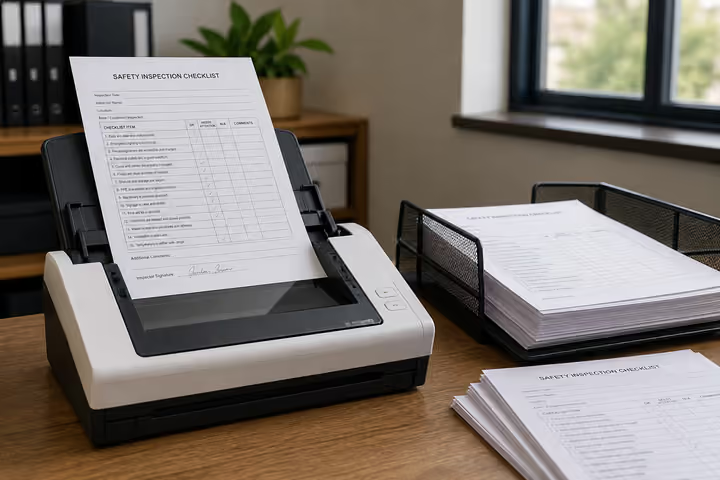
2 We convert them into AuditDAT
-

3 Your demo uses your inspections