
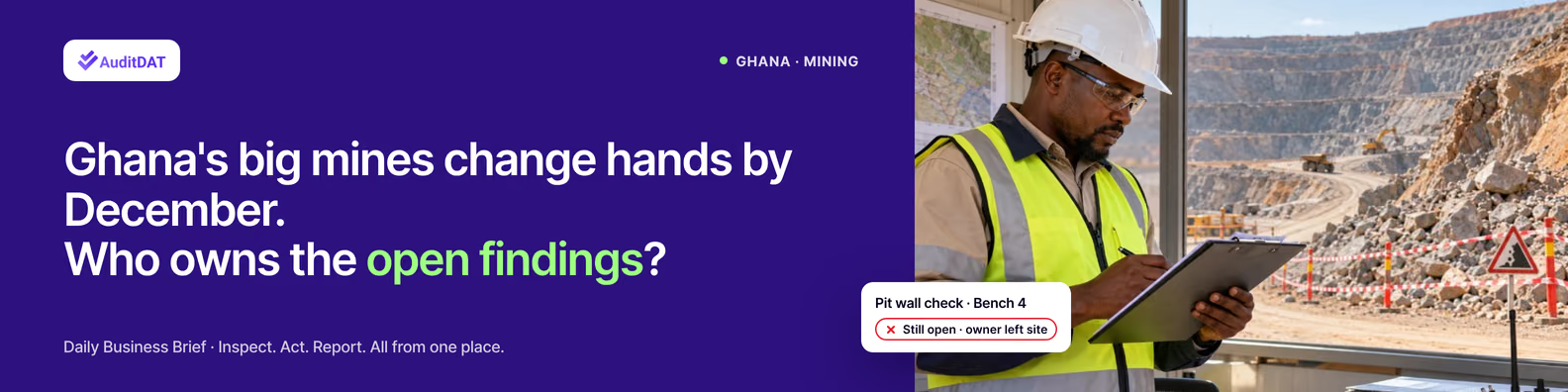
Ghana's contract-mining deadline: who owns the open findings when the contractor changes?
 Joseph Abeiku Ansah-Gordon
Product Owner/Lead Marketing ·
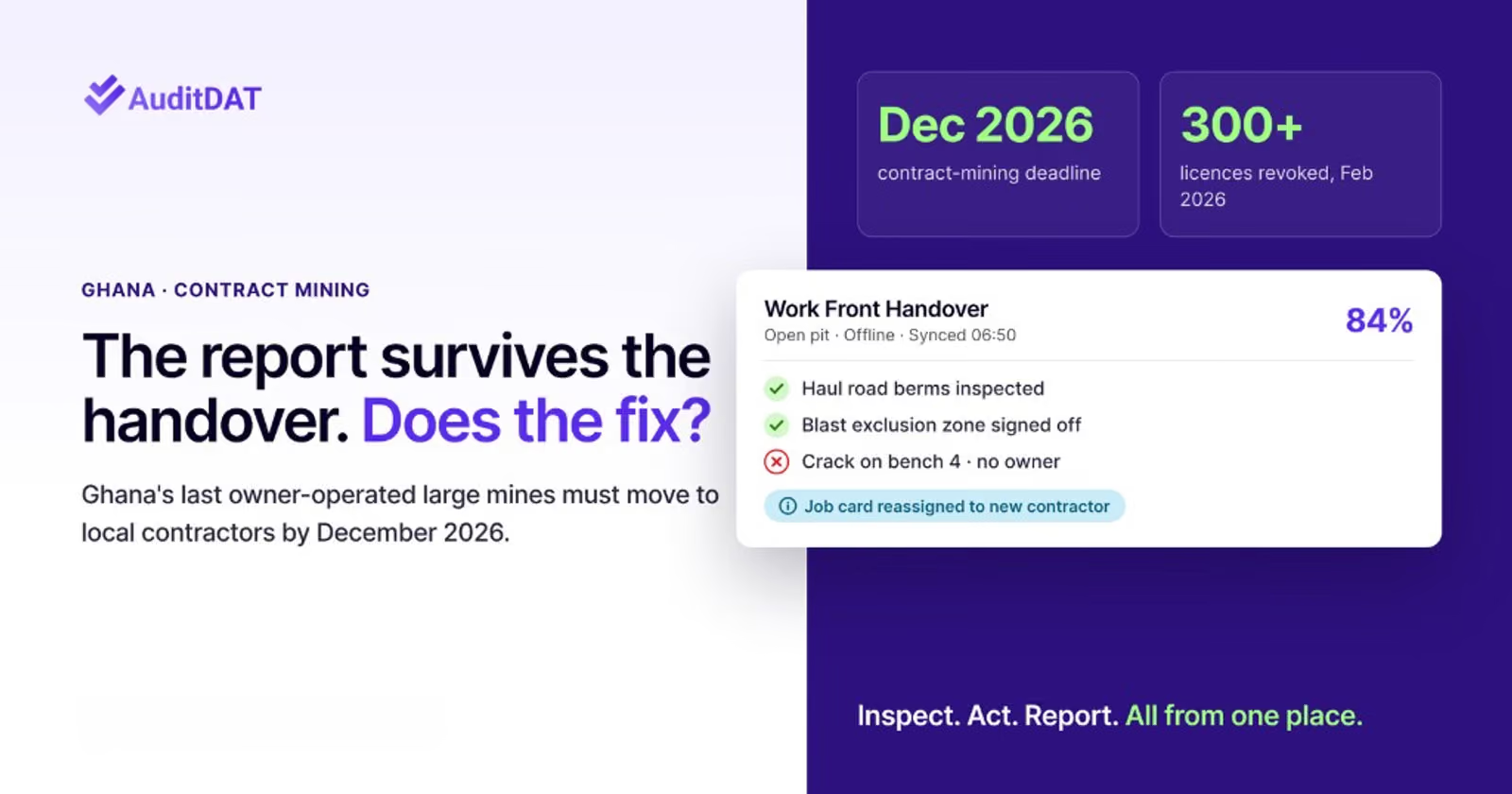
Ghana's largest gold mines are being told to hand their mining operations to local contractors by December 2026. The inspection report will survive the handover. Will the problems it found be fixed?
Share


The deadline
In April 2026, Reuters reported that Ghana's Minerals Commission had told Newmont, AngloGold Ashanti and Zijin to move their mining operations to local contractors or face sanctions. Letters sent in October 2025 and January 2026 set a deadline of December 2026. The three are the only large miners still mining with their own staff; almost every other operator has already moved to contract mining.
The rules behind the order were revised in January 2025. Surface mining must be carried out by fully Ghanaian-owned firms, and underground mining by companies at least 50% Ghanaian-owned. A government official told Reuters that non-compliant miners face "a huge fine for the first step", and that the regulator can ultimately shut a mine.
The policy aims to build Ghanaian mining-services capacity and keep more value in the country. It also means that, within months, workforces, fleets and work fronts at some of the country's biggest mines will change hands.
A regulator that has moved to enforcement
The handover is happening under a regulator that has stopped treating compliance as paperwork. In February 2026, the Minerals Commission revoked more than 300 small-scale licences it said were fraudulently acquired or dormant. It announced a review of the Minerals and Mining Act, the phasing out of Development Agreements and a new medium-scale mining category. District Mining Committees have been activated so that no licence is processed without local authorities' input.
"Local content is no longer a compliance checkbox," Minerals Commission CEO Isaac Tandoh said. "It is now a strategic priority in every mining agreement."
The stakes are high. The Ghana Chamber of Mines' provisional figures put 2025 gold output up about 21% on 2024, a record year. Mines producing at that pace cannot afford stoppages, and a regulator in enforcement mode will not overlook gaps.
Where findings fall through the gap
An inspection report can be complete while the problem it describes is still open. A handover is when that gap grows. Think of an unstable bench, a damaged berm on a haul road, a worn guard on a crusher or an overdue ground-control action. Each was logged by the outgoing team, but none is guaranteed to reach the incoming contractor's to-do list.
The usual failure points are predictable:
- Different forms, different habits. The owner's checklists and the contractor's checklists don't match, so findings get rewritten or lost in translation.
- Open actions live in someone's head. The supervisor who raised a finding leaves with the old crew, and the context leaves with them.
- Paper and WhatsApp don't transfer. Photos, signatures and close-out notes sit in phones and site-office files that never reach the new team.
- The owner still carries the risk. Moving operations to a contractor does not move accountability to the regulator, the community or the board. Owners need to see contractor findings and their status in real time.
The question for every Ghanaian mine and mining contractor this quarter is simple: on the day of handover, can you list every open finding, its owner and its due date?
How can AuditDAT make a difference
AuditDAT by UPDAT gives mine owners and their contractors one shared record of every inspection, finding and fix, so nothing gets lost at handover. Inspect. Act. Report. All from one place.
- One checklist for owner and contractor. Build your inspection templates once, covering pit walls and benches, haul roads, plant guarding and ground control, and give every contractor the same forms. Or let UPDAT's team convert your existing checklists for you.
- A fail becomes a job card. Every failed item turns into an action with a named owner and a due date. When crews change, the action stays open until it is closed, with photos.
- See every open finding in one place. Filter actions by site, contractor or status, so the owner sees contractor performance as it happens, not at the monthly meeting.
- Do the check in the pit, even with no signal. AuditDAT works offline and syncs when the supervisor is back in range.
- The report is ready when the inspection ends. Scored, time-stamped and stored with a full audit trail for the Minerals Commission, auditors and the board.
The handover deadline is fixed. Whether findings get lost in it is up to the mine and its contractors.
FAQ
Questions on this note
On handover day, can you list every open finding?
In AuditDAT a failed item becomes a job card with an owner and a due date. The action stays open when the crew changes, until it is closed with photos.
Who keeps an open finding when the contractor changes?
The finding stays on the site. In AuditDAT the job card keeps its owner and due date when the crew changes, and the mine owner can still see it.
What happens to WhatsApp photos and paper notes at handover?
They stay on phones and in site-office files. In AuditDAT the photos, signatures and close-out notes stay on the inspection, so the incoming contractor can open them.
Does handing the pit to a contractor hand over the safety risk?
No. The mine owner still answers to the regulator, the community and the board. AuditDAT shows contractor findings and whether each one is still open.
Free with your demo
Send us 5 checklists
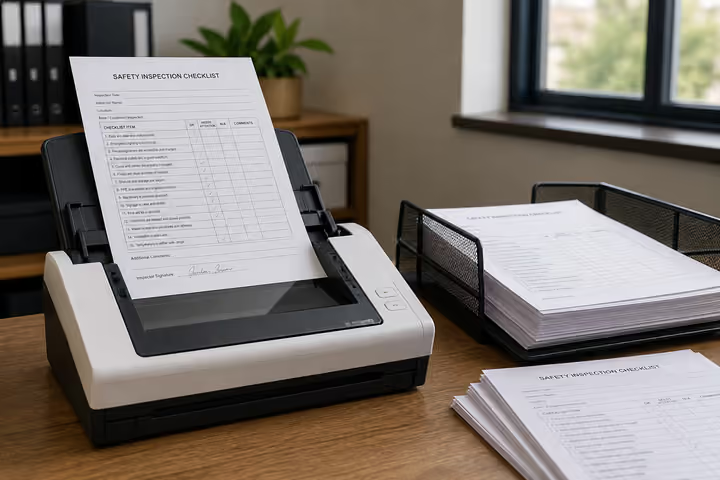
Send five inspection forms your team uses today, as PDF, Excel or Word files, or a photo of the paper form. We build them in AuditDAT and show you the product running your own process.
- Up to 5 checklists, as they are used on site today
- We set up scoring, photos and signatures for you
- Your demo uses your inspections, not a sample tour
Bring your forms as PDF · Word · Excel · photo of paper

Included when you book a demo. No extra fees.
-

1 You send paper or Excel forms
-
2 We convert them into AuditDAT
-

3 Your demo uses your inspections